What passive cooling with copper pipe and aluminum can and can't do
A fanless PC build shows how far conduction and rising warm air reach before one small fan has to finish the job.
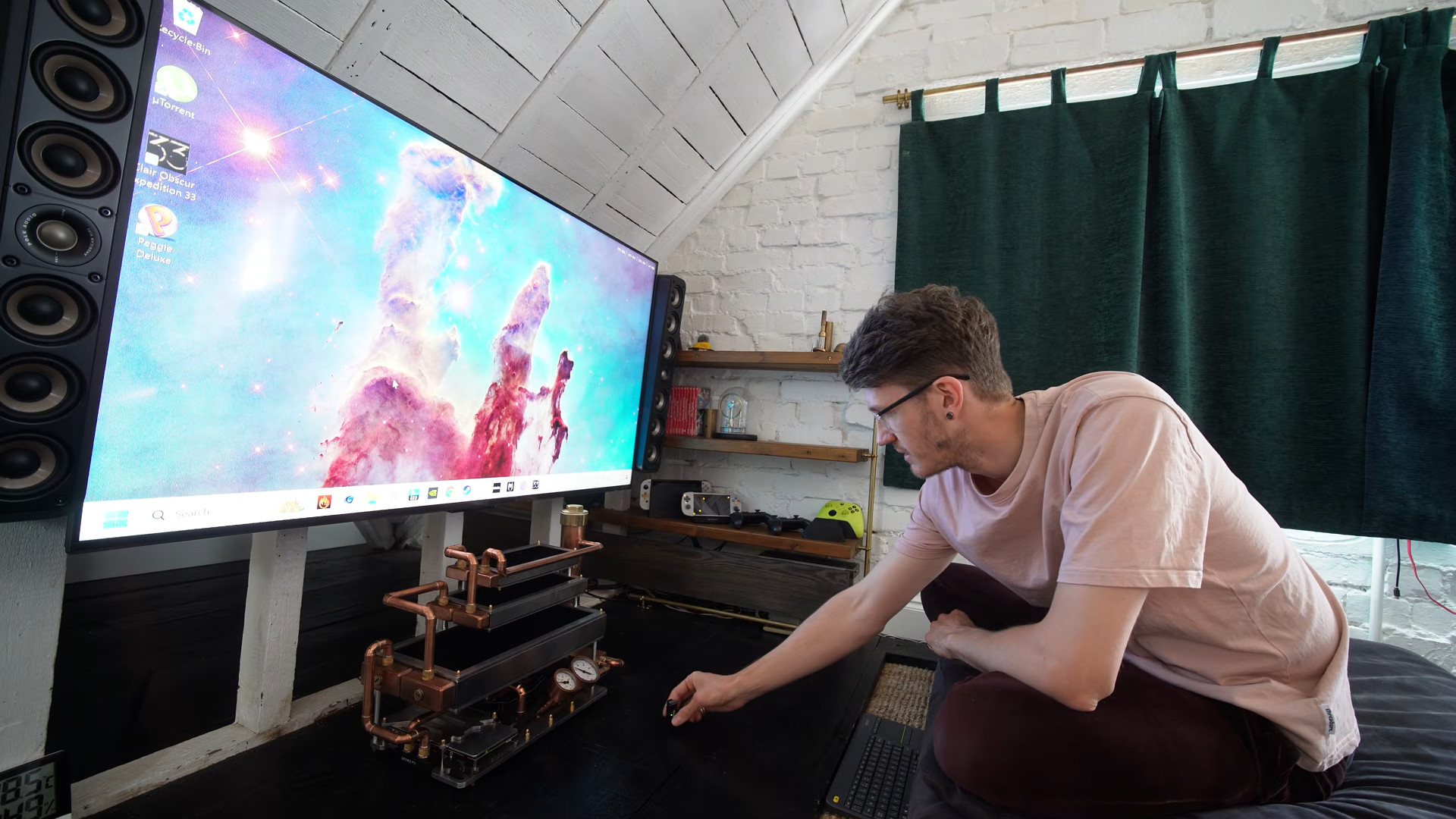
The builders at Billet Labs wanted a gaming PC that ran in silence. No fans at all. Hackaday's Fenix Guthrie wrote up the attempt on October 5, and the result teaches you something about how far heat moves on its own before something has to push it.
The trouble is the components. 'Modern components are highly efficient at producing monumental quantities of thermal energy,' Guthrie wrote. A fanless build has to carry all of that away with nothing but conduction and the slow drift of warm air rising off the metal.
So the first move was to turn the case into a heat sink. Billet Labs used an aluminum block as the base, thermal paste under the power supply, thermal pads under the motherboard, so heat flowed out of the parts and into the metal. Hackaday reported the block cooled both the motherboard and the graphics card.
The rest of the heat went into a water-cooling loop. The builders made it from household copper piping they soldered together by hand. They stacked three radiators horizontally, the idea being that warm air would rise through them with no fan, and fitted pressure and temperature gauges to watch the loop.
Two things went wrong. Water running past the pressure gauge made a lot of noise, which is the one thing a silent machine can't have. And the stacked radiators, left to natural airflow, could not keep the PC cool with a game running.
The fix turned out to be small. The builders removed the pressure gauge and dropped a single 120mm fan between two of the smaller radiators. That cleared up both problems and left them with a quiet gaming PC. Conduction and a soldered copper loop did most of the work. One modest fan finished the job that passive airflow could not.
Underneath, this is a lesson in how heat travels, and the rules hold far from a computer case. Conduction moves heat through solid contact, which is why the aluminum block and the paste and the pads mattered. Convection carries it off in moving air, and on its own that air drifts slowly. Good metal contact pulls heat out of whatever is hot. Something then has to take that heat away, by natural draft, or, when the draft falls short, by a fan.
Sources
- Failing to Make a Fanless PC · Hackaday