How to find the planets in October's sky by eye
Jupiter, Mars and Saturn at dawn, a moon that briefly covers Jupiter on the 6th, and Venus fading from the evening by month's end.
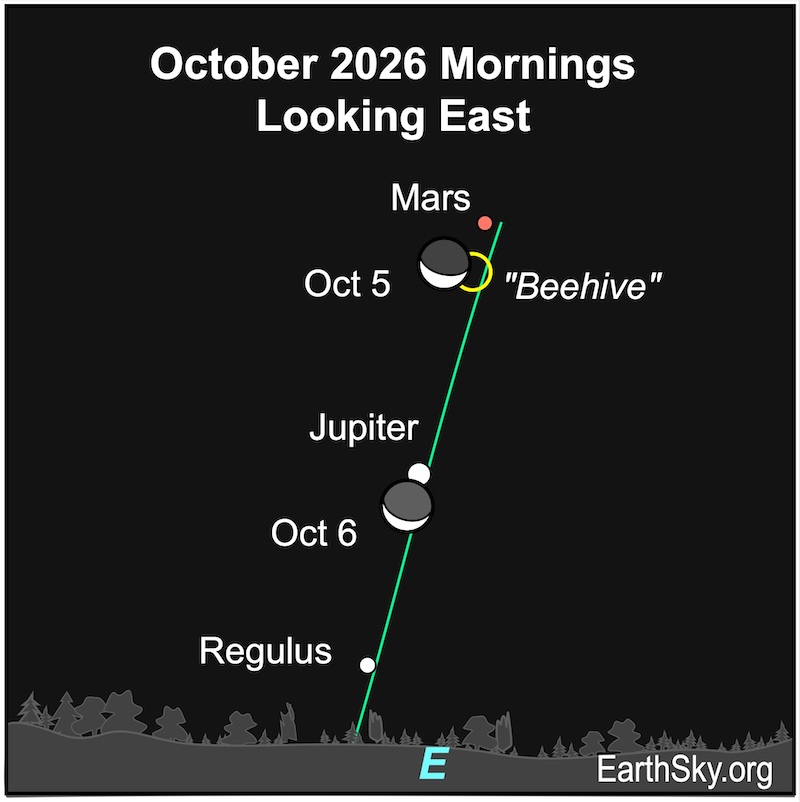
The brightest point of light in the predawn sky this month is not a star. It's a planet, and telling the two apart is the kind of skill that outlasts any phone. EarthSky published its guide to October's visible planets on October 5, written by Marcy Curran, and it lays out where to look with nothing but your eyes.
In the morning sky, the guide lists Jupiter as the brightest planet, with the red glow of Mars beside it and Saturn setting in the west. The evening brings Venus and Saturn. Venus disappears early in the month, while Saturn brightens and stays up all night, according to EarthSky. Knowing which of those bright points is a planet, and where each one sits on a given night, is the first step in reading the sky without an app.
The standout comes on the morning of October 6. According to EarthSky, the waning crescent moon lies near Jupiter, Mars and the Beehive star cluster, a loose knot of stars in the constellation Cancer. "Tomorrow morning, look for the moon near Jupiter, Mars and the Beehive," the guide said. Grouping the moon with the planets near it is one of the oldest ways to find your bearings overhead.
For some observers the moon does more than pass nearby. EarthSky said that around 10 UTC the moon would occult Jupiter, sliding in front of it, for watchers in parts of southeast Canada, most of the United States, Mexico, the Caribbean and parts of Africa. Watching one world cover another is a reminder that the points overhead are moving bodies, not fixed decoration.
A few mornings later, on October 11, Mars passes through the Beehive star cluster in Cancer, the guide said. The cluster sits between the bright stars Regulus, Pollux and Castor. That gives you a way to find Mars: work outward from stars you can already name, and let the fainter cluster fill in between them.
Venus is on its way out of the evening. EarthSky said the planet reaches inferior conjunction on October 23-24, the point that ends its prominent evening appearance. To catch it low in the west, the early part of the month is your window.
The guide recommends binoculars for the star clusters and fainter objects, which bring the Beehive's scatter of stars into view. For precise times and positions from your own spot on Earth, it points readers to Stellarium Online rather than any general chart. What you see depends on where you stand and when you look up.
Sources
- Visible planets and night sky guide for October · EarthSky, Tonight