This 1960s oscilloscope came with its own spool of repair solder
Seventy pounds of tubes and glass, built to be opened up and fixed by hand in the field.
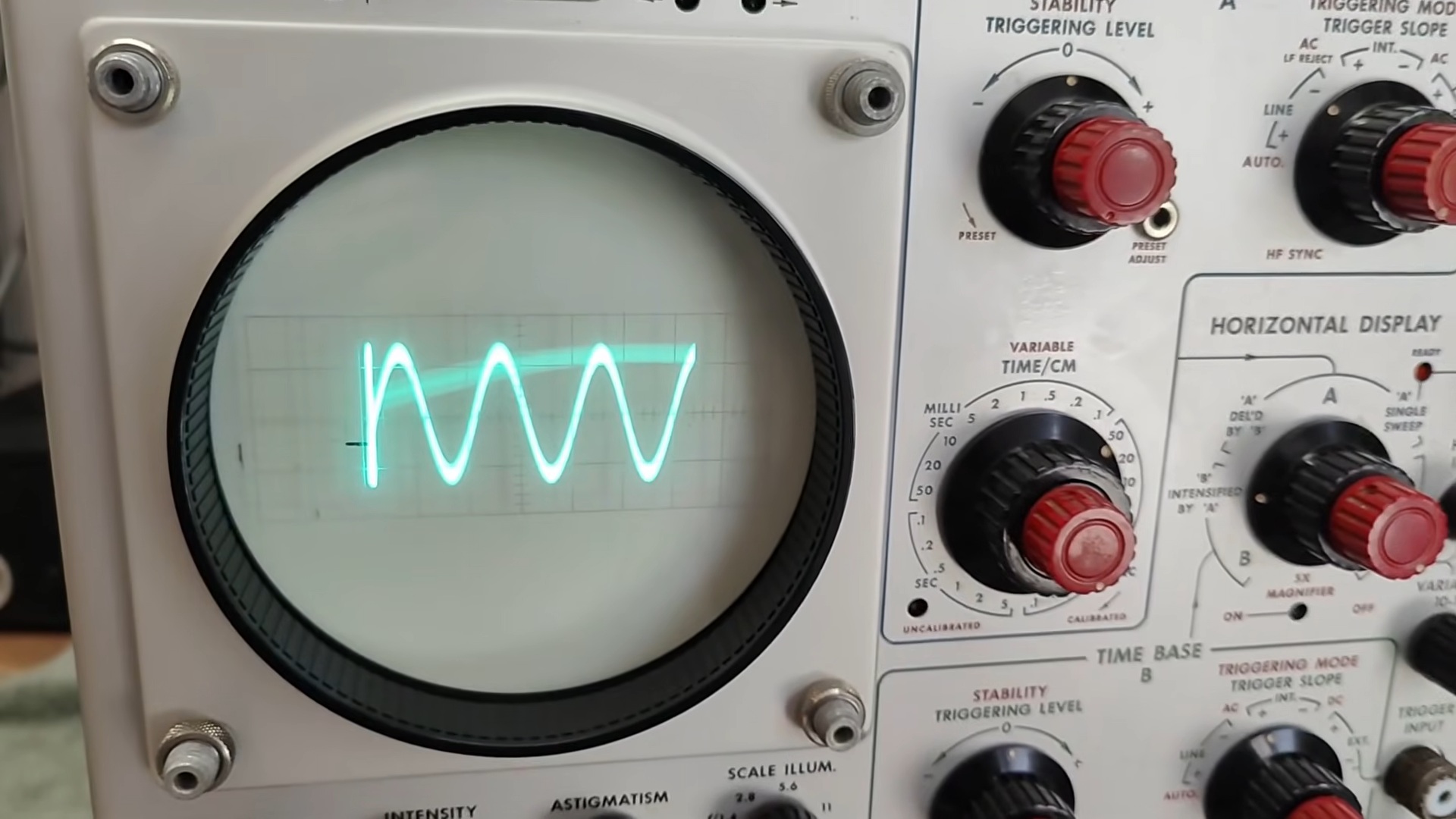
A 1960s Tektronix 545A oscilloscope weighs almost 70 pounds and holds 81 vacuum tubes. It was built to be opened up and repaired by hand. In a post published October 4, 2026, Hackaday writer Al Williams describes a teardown video in which a maker identified as Thomas works through one of these machines, an instrument that, as Williams puts it, is 'almost 70 pounds of tubes, transformers, and glass.'
The video made Williams nostalgic, he writes, 'because we miss the days when our oscilloscopes were "mainframes."' The comparison is literal as much as sentimental. The 545A is not a handheld tool, and it is not a box that sits on a bench corner. It is a piece of furniture with two handles for carrying, and it draws roughly 500 watts of power to do its job.
Most of that bulk is tubes. According to the post, 'the mainframe part of the scope has 75 tubes, and the plugin, a type D, has six tubes, too.' That plug-in is part of what made the instrument flexible. The 545A accepted interchangeable vertical-section plug-ins, so a user could swap modules in and out to change how the scope behaved instead of buying a new instrument.
Eighty-one tubes is a lot of points of failure, and that is part of what makes the machine instructive. Each tube is a discrete, replaceable component rather than a sealed chip. A fault can be traced to a single part, and that part swapped out. Nothing about the instrument is hidden behind a surface that cannot be opened. In a world where replacements arrive by mail order today, that may read as a quaint inconvenience. In a world where nothing arrives at all, it is a feature.
The detail Williams lingers on is small, and the lesson in it is large. The scope used ceramic connection points that did not take ordinary solder well. So the factory kept a spool of silver solder inside the unit itself, stored where a technician would find it when a repair was needed. The machine shipped carrying the material required to fix it.
That is the thread worth pulling for anyone thinking about what survives without a supply chain. A tool that comes with its own repair stock, built from discrete parts a person can see and reach, is a tool that can be kept running far from a factory or a parts catalog. The design assumes the person using it will also be the person opening it.
The scope Thomas examined was not working when he started. According to the post, he made significant progress toward restoring it, a sixty-year-old instrument coaxed back toward life by hand. Williams's write-up is short and points readers to Thomas's video rather than walking through the repair step by step. But the lesson sits in plain view: things built to be understood can be brought back.
Sources
- Tearing Down a Heavy Oscilloscope · Hackaday